
Halloween has nothing to do with it.
Or rather… it does.
Because there’s a kind of ghost far more dangerous than those you see in films:
translation mistakes that come back to haunt brands for years.
They have cost millions. They have shaken international groups.
And no business is completely safe.
Here’s an autopsy of the worst “linguistic monsters” in modern history — and, above all, what they teach us.
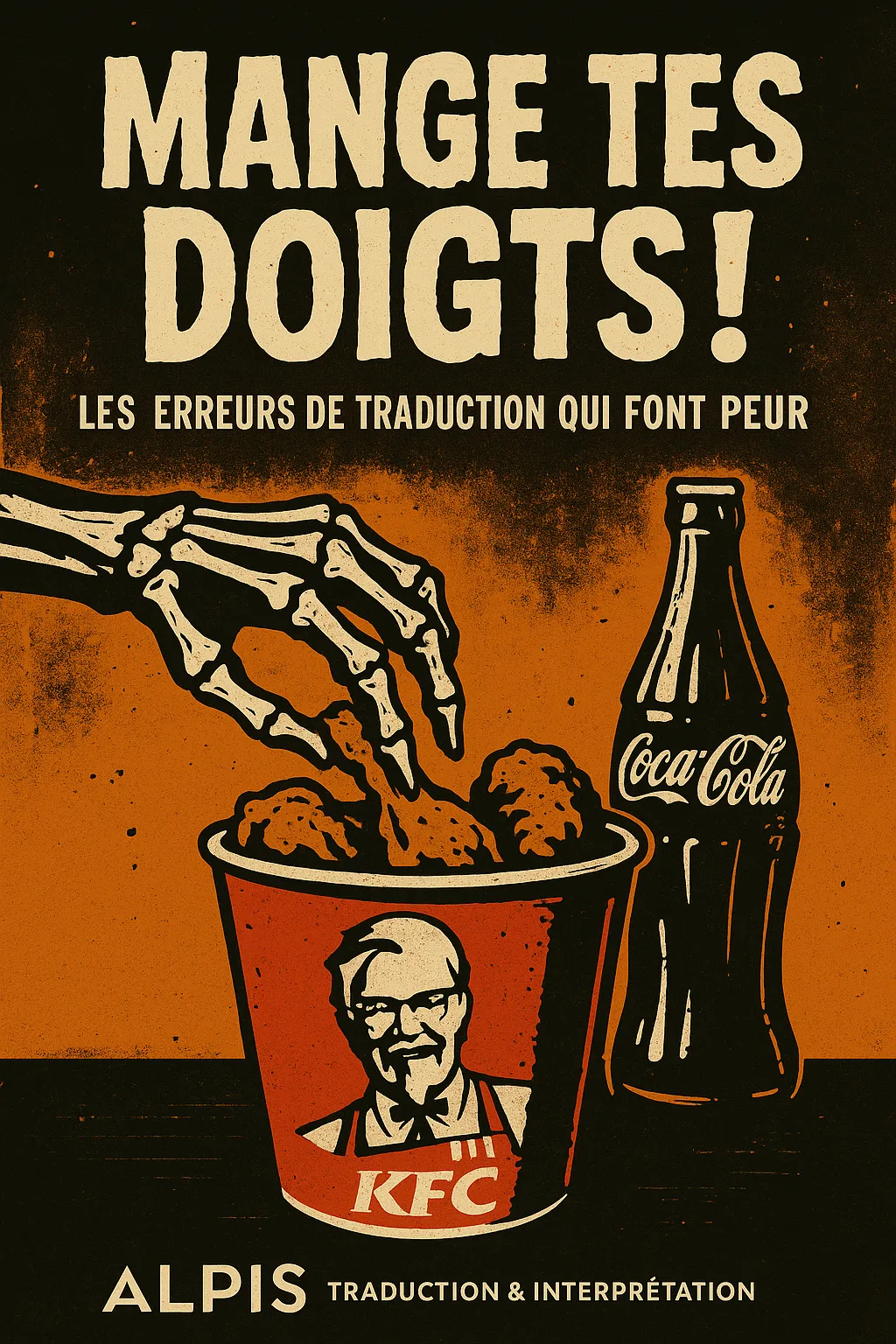
When KFC told its customers: “Eat your fingers.” 🍗😱
This is perhaps one of the most famous translation blunders in history.
Indeed, KFC’s iconic slogan — “Finger lickin’ good” — was launched in China with a rather literal translation:
“Eat your fingers.”
The result was deeply awkward: a fast-food chain inviting self-mutilation…
Chinese consumers first laughed, then decided the brand didn’t understand their culture at all.
Moral of the story: to understand a market, you must first understand its words.
Coca-Cola and the “wax tadpole” incident 🐸💀
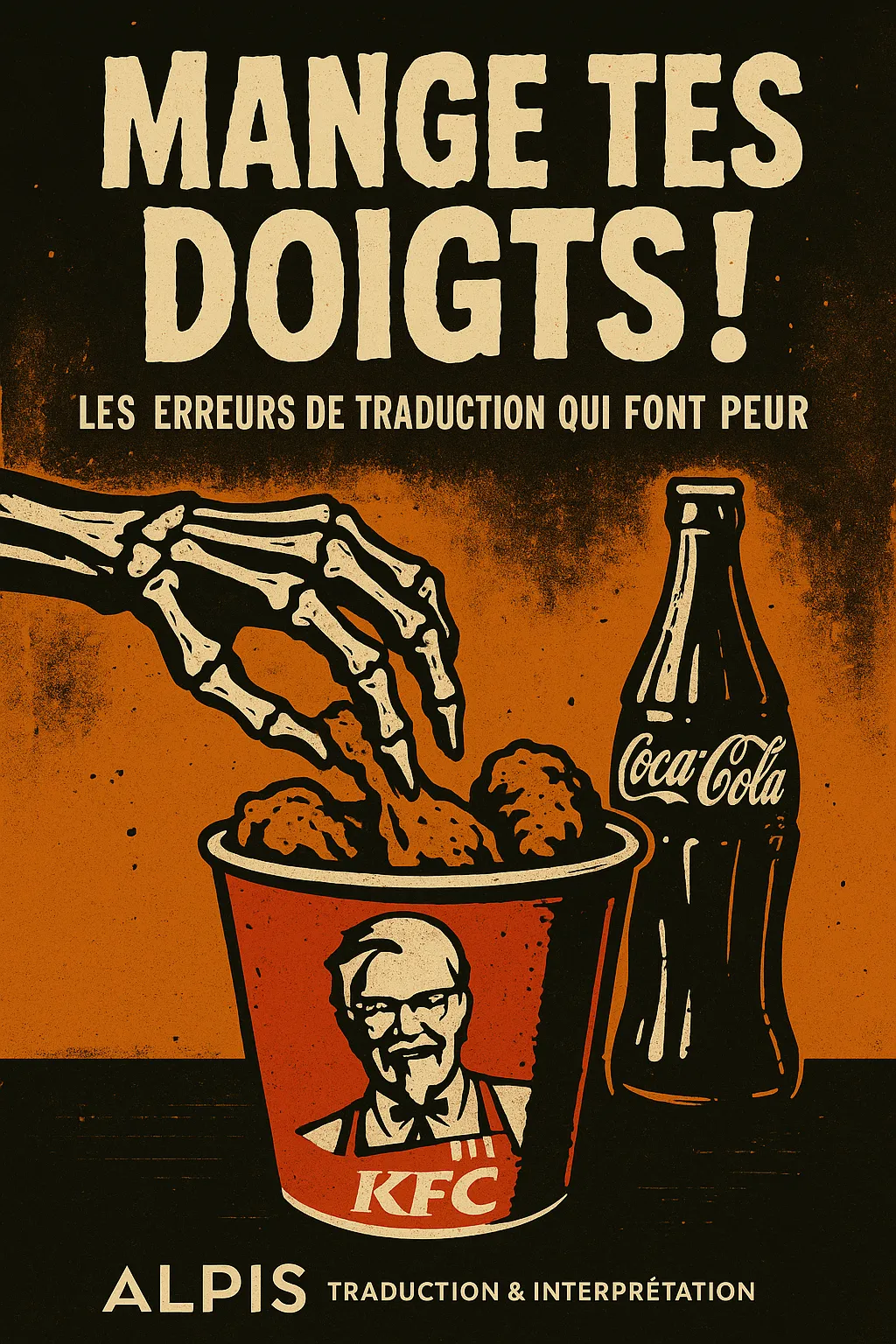
When Coca-Cola entered China, they simply wanted a transliteration.
The problem: before the company chose the right characters, local shopkeepers improvised.
The result: Ke-Kou-Ke-La, which, depending on the province, could mean:
“bite the wax tadpole” or “mare stuffed with wax”.
Not exactly “refreshing”, is it?
The multinational had to start over, rebrand, reprint, re-explain.
It was a financial black hole.
Lesson: a poorly translated brand can destroy trust before it even exists.
Why a simple pumpkin can ruin your campaign 🎃🌍
We always think that “little words” are harmless.
That’s a mistake.
“Citrouille” translates as “pumpkin”, yes.
But in the English-speaking world, squash is a generic term covering several types of gourds.
In German, “Kürbis” means pumpkin… but it’s also a surname.
And in Spain, “calabaza” means pumpkin and being rejected in love (“se prendre une calabaza”).
Imagine a poorly localised Halloween campaign:
You wanted to talk about a vegetable, and you ended up announcing your product would “give customers the brush-off”.
A literal translation can be enough to kill a campaign.
Translation mistakes aren’t accidents… but failed systems 🧠
All these disasters have one thing in common:
someone thought a literal translation was “good enough”.
The truth?
You’re not just translating words, but intentions, cultural associations, undertones, emotions.
You’re translating one world into another.
That’s precisely where machines fail — and humans excel.
Indeed, machine translation can be “correct”, but never “intelligent”.
What Alpis does: exorcising words before they become nightmares 🎯
At Alpis Translation & Interpretation, we see these cases every week.
Businesses convinced that “Google Translate will do the job”.
Entrepreneurs discovering their slogan means something entirely different.
International companies who think they’re speaking correctly… but are missing the mark.
We analyse, we adapt, we localise.
We avoid ridicule, we avoid lawsuits, we avoid bad publicity.
We exorcise your words before they turn against you.
Because in business as in life, it’s never the ghost you should fear.
It’s the bad translation.
>> Ask us for quality translations here ! <<