
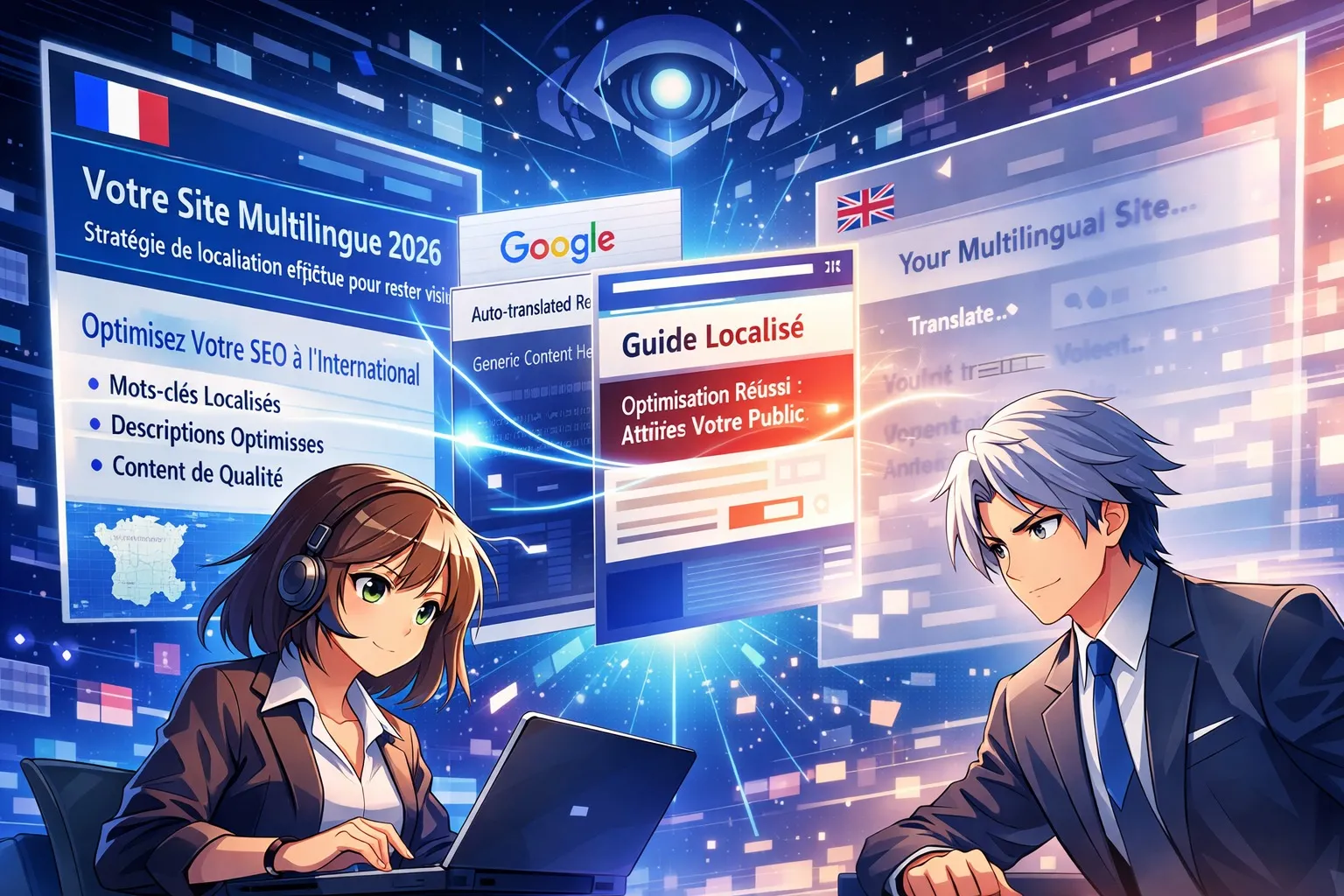
Did you think that an “EN” button or automatic translation was enough to establish an international presence?
That was already risky yesterday. In 2026, it’s become dangerous.
The hot topic in the translation world is no longer just the speed of AI. It’s a much more pressing question: how do you stay visible when Google, search engines and AI assistants decide for themselves which language version to display… or even translate your content for you?
The signal is clear. Google states in black and white that it can display translated results: the title, snippet, and sometimes the page itself via Google Translate after the click. Google also recommends explicitly specifying the language versions of a page with localised variants and hreflang, rather than letting the engine guess. In short: if you don’t structure your multilingual presence, the machine can come between your brand and your reader.
And this is far from trivial. As of 20 April 2026, English accounts for 49.6% of websites whose language is identified by W3Techs. French represents only 4.5%. This means two things: firstly, the web remains massively unbalanced; secondly, each well-designed language version can become a real driver of visibility.
What’s really changing is the arrival of AI-assisted search. A study by Weglot, reported on 14 November 2025 by Search Engine Journal, analysed 1.3 million citations in Google AI Overviews and ChatGPT. The finding: translated sites achieved up to 327% more visibility in AI Overviews, as well as 24% more citations per query compared to non-translated sites. It’s a study sponsored by Weglot, so it should be read with discernment, but the business signal is too strong to ignore.
In other words, translation is no longer just a back-office task. It’s now a matter of SEO, brand control, conversion, and even AI traffic.
This is where many companies go wrong.
They translate their pages. But they don’t localise their key phrases. They translate their product listings. But not their metadata. They launch a foreign version. But without a clear structure, without hreflang, without cultural adaptation, without human validation. The result: they are present… without truly being found. Or found… without convincing anyone.
“Assembly line” translation produces text.
Strategic localisation, on the other hand, produces visibility.
And tomorrow, it will also generate citations in AI engines.
In practical terms, in 2026, a good multilingual strategy is no longer about simply “putting the site in English”. It’s about:
- publishing genuine local versions;
- adapting keywords to the target market;
- translating titles, descriptions and SEO elements as well;
- technically structuring the variants;
- ensuring human proofreading for sensitive, commercial or legal content.
The current trend in translation is therefore not just AI.
It’s what comes after automatic translation.
The moment when businesses finally understand that a translated text is only valuable if it remains visible, credible and persuasive in the client’s language.
At Alpis, this is precisely where we come in: when it’s no longer just about translating words, but about conveying a message, an intention and performance from one market to another.
Want a multilingual website that truly speaks to your clients… and not just to machines? Contact Alpis.
Sources
- Google Search Central, “Translated results in Google Search”: Google can translate the title, snippet, and then the page into the user’s language.
- Google Search Central, “Localized versions of your pages”: Google recommends explicitly specifying language/local versions and the use of
hreflang. - W3Techs, 20 April 2026: English 49.6% of sites, French 4.5%.
- Search Engine Journal, 14 November 2025, sponsored post relaying a Weglot study: 1.3 million citations analysed, up to 327% more visibility for translated sites in AI Overviews.
- CSA Research, “Can’t Read, Won’t Buy – B2C”: survey of 8,709 consumers in 29 countries, often cited as a reference on reading and purchasing preference in one’s native language.