
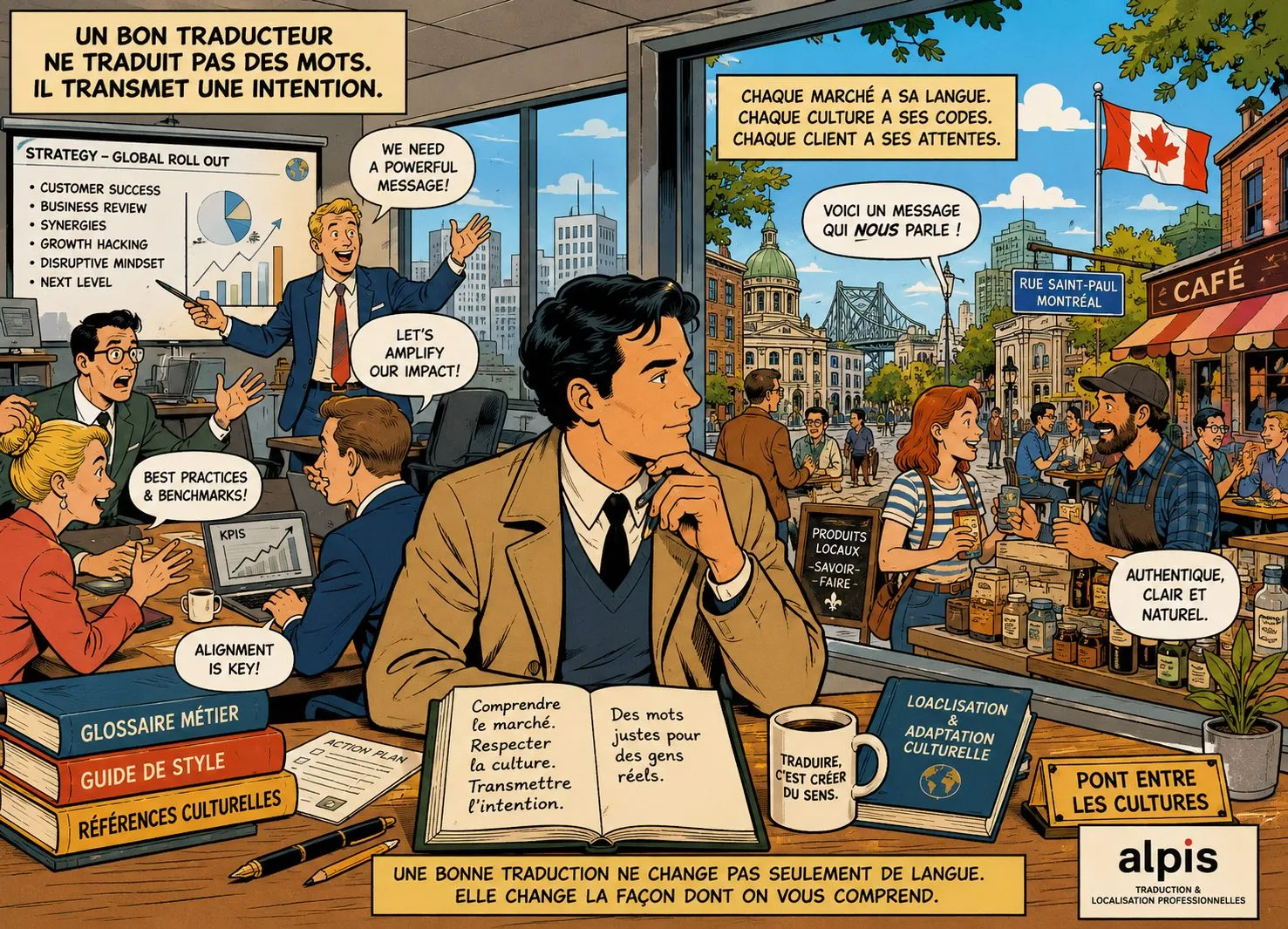
Why a good translator never translates word for word
Yes.
And that is precisely what traps so many businesses today.
Because they still believe that translation is simply about swapping English words for French ones. As if language were nothing more than a collection of interchangeable vocabulary.
In today’s economic reality, this view has become dangerously naïve.
A poor translation can ruin an entire international strategy without containing a single spelling mistake.
It can make a brand seem artificial.
Cause a client to lose trust.
Break an international SEO strategy.
Destroy the premium perception of a product.
Or simply give that strange impression that something “sounds off”.
And consumers pick up on this instantly.
Major agencies no longer recruit bilinguals. They look for people who understand a market.
A recent job advert posted on LinkedIn is telling of this shift.
The company is seeking an English → Canadian French translator for localisation projects.
But when you read the advert carefully, one detail stands out:
The core of the role is not just about “speaking two languages”.
The translator must:
- culturally adapt content,
- maintain terminological consistency,
- work with specialised glossaries,
- collaborate with product teams,
- integrate client feedback,
- understand the expectations of the local market.
In other words:
today’s translator is expected to understand an entire economic environment.
And that makes perfect sense.
A language is never just a language.
Let’s take a simple example.
A French company decides to sell its products in Quebec.
On paper, everything seems easy:
“The clients speak French.”
So many companies think it’s enough to quickly translate their existing content.
A classic mistake.
Quebec French has its own cultural references, its own relationship codes, its own approach to marketing, to client relations, and even to commercial tone.
A phrase considered elegant in Paris may come across as cold in Montreal.
A very “corporate France” turn of phrase can sound pretentious locally.
A slogan can completely lose its emotional impact.
And sometimes, certain translations even give the impression that a company doesn’t really understand its target market.
That’s exactly why localisation has become so strategic.
The true role of the modern translator: conveying intent.
The best translators no longer simply translate words.
They translate:
- an emotion,
- a promise,
- a positioning,
- a client experience,
- a brand culture.
This is especially clear in sectors such as:
- luxury,
- video games,
- wine,
- cosmetics,
- tourism,
- e-commerce,
- tech,
- premium industry.
A translator specialising in wine must understand appellations, cultural practices, sensory vocabulary, and sometimes even the history of the terroirs.
A cosmetics translator must master regulatory requirements, marketing nuances, and the emotional expectations of the end client.
A video game translator must preserve the player’s narrative and emotional experience.
We are a long way from a simple bilingual dictionary.
AI already translates very well. And that’s precisely what is changing the profession.
Today, artificial intelligence produces technically correct translations in seconds.
For simple, standardised or purely informative content, it already works very well.
But the more strategic the content…
…the more important cultural understanding becomes.
Because AI can translate sentences.
But it still struggles to grasp:
- cultural nuances,
- local perceptions,
- social signals,
- implicit references,
- the psychology of a market,
- or the emotional coherence of a brand.
That’s where human value becomes decisive.
At Alpis, we believe a good translator must understand the real world.
A good translator must understand:
- how a business sells,
- how a client makes decisions,
- how a brand builds credibility,
- how an economic sector operates,
- and how a culture perceives a message.
Because ultimately, a translation is never neutral.
It can win a market.
Or quietly lose it.
Sources
- Lionbridge Games Careers
- memoQ Translation Technology
- CSA Research – Localization Industry Overview
- Alpis Professional Translation